Category: Uncategorized

  • How to Spec Custom Printed Hand Warmers: Print Methods, Sizes, and Minimums

    How to Spec Custom Printed Hand Warmers: Print Methods, Sizes, and Minimums

    A branded hand warmer is one of the few giveaways people actually keep in a pocket and use, which is why the print specification deserves more thought than it usually gets. The warmer itself is a sealed sachet of iron powder, salt, activated carbon, and vermiculite that heats up when the pouch is opened and the iron begins to oxidize in air. That reaction typically reaches somewhere around 126 to 144°F and holds usable heat for roughly eight to ten hours, depending on the size of the sachet. Adding your brand does not change any of that. What it changes is the wrapper, and there are two very different ways to put a logo on it.

    Two routes to get your brand on the wrapper

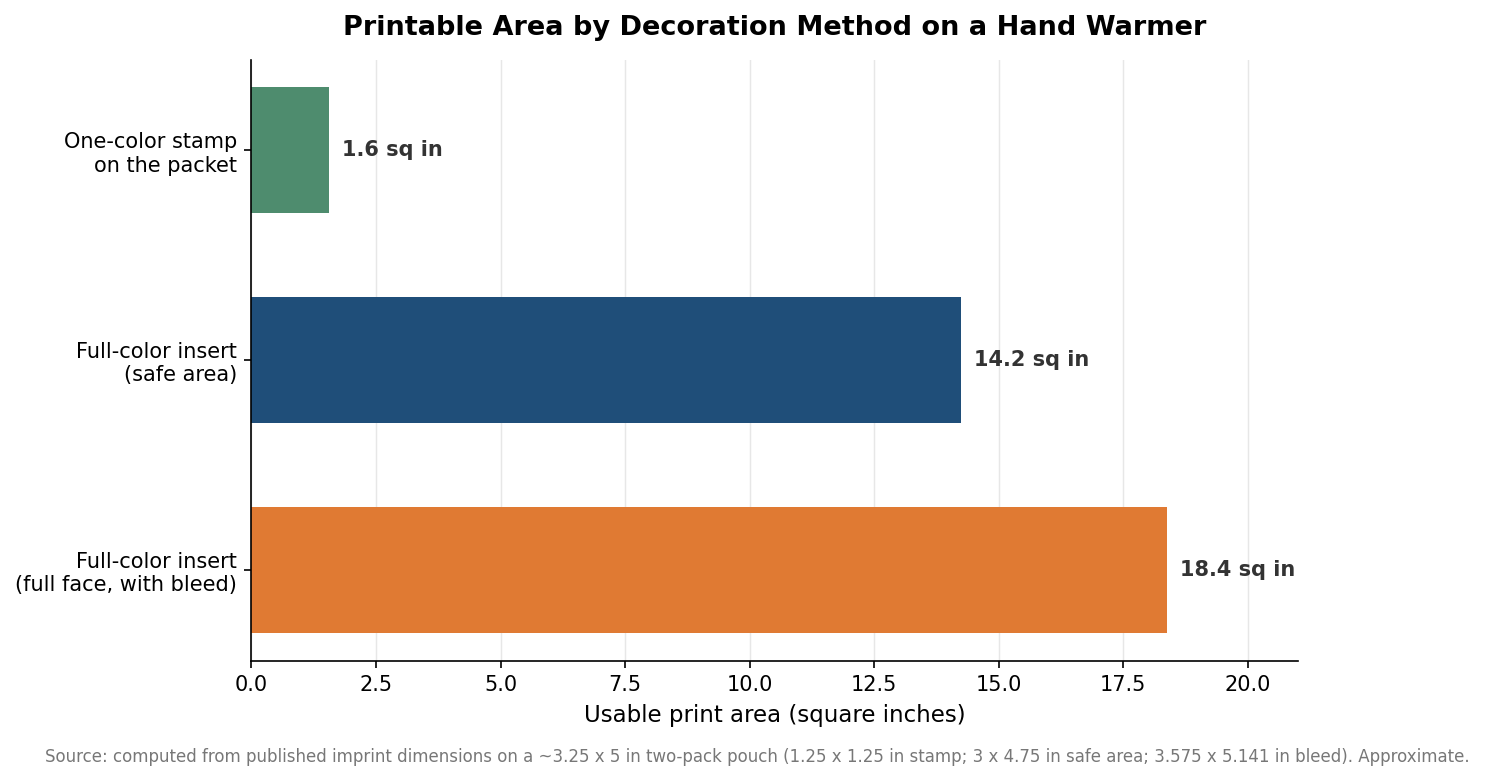
    The first route is a direct imprint on the sealed packet. A single ink color is printed onto the existing film in one location, usually inside a small window of about 1.25 inches square. Because it reuses stock packaging and a single screen, this method carries the lowest setup effort and the simplest quote. For a plain logo, a URL, or an event name, it is hard to beat on price.

    The second route is a full-color printed insert or label that covers the entire face of the pack. Here the artwork is printed on its own stock and either wrapped around or inserted with the warmer, so you get four-color process printing across the whole front. On a common two-pack pouch measuring roughly 3.25 by 5 inches, the safe print area runs about 3 by 4.75 inches, and the design bleeds out to around 3.575 by 5.141 inches so the ink runs off the edge cleanly. This is the route to choose when you want a photograph, a gradient, a sponsor lockup, or a scannable QR code, and it is what most trade-show and retail programs use. Setup is more involved, and the unit price depends on quantity and on whether the pack holds one warmer or two.

    What you can actually print, and how big

    The gap between those two methods is not subtle. A one-color stamp gives you well under two square inches to work with, while a full-color insert opens up roughly fourteen square inches of safe area, or a little over eighteen once you count the bleed. That is close to a tenfold difference in usable canvas, and it is the single biggest reason a program moves from a stamp to a wrap.
    Horizontal bar chart comparing printable area of a one-color packet stamp versus a full-color insert
    A full-color insert offers roughly ten times the usable print area of a single-color packet stamp.

    Two dimensions matter when you lay out the art. The safe area is where anything you cannot afford to lose — logos, legal copy, a phone number — has to live, because trimming and folding tolerances eat a few millimeters at every edge. The bleed is the slightly larger rectangle you extend background color and imagery into so that no unprinted white sliver shows if the cut drifts. Keep type and key marks inside the safe area, push backgrounds out to the bleed, and the piece will look intentional rather than cropped. Because the warmer is a soft, slightly puffy sachet, avoid thin hairline rules and tiny reversed-out text that can distort when the pack flexes.

    Minimums, setup, and what really drives the price

    Three things decide what a run costs: the quantity, the number of print colors, and the pack count. Customized Hand Warmers starts at a minimum order of 12 per design, so a small team giveaway and a stadium promotion are both easy to order. Spot color stays simple while you need one or two inks; once you are past two colors, full-color process is usually the better-looking choice and no harder to set up.

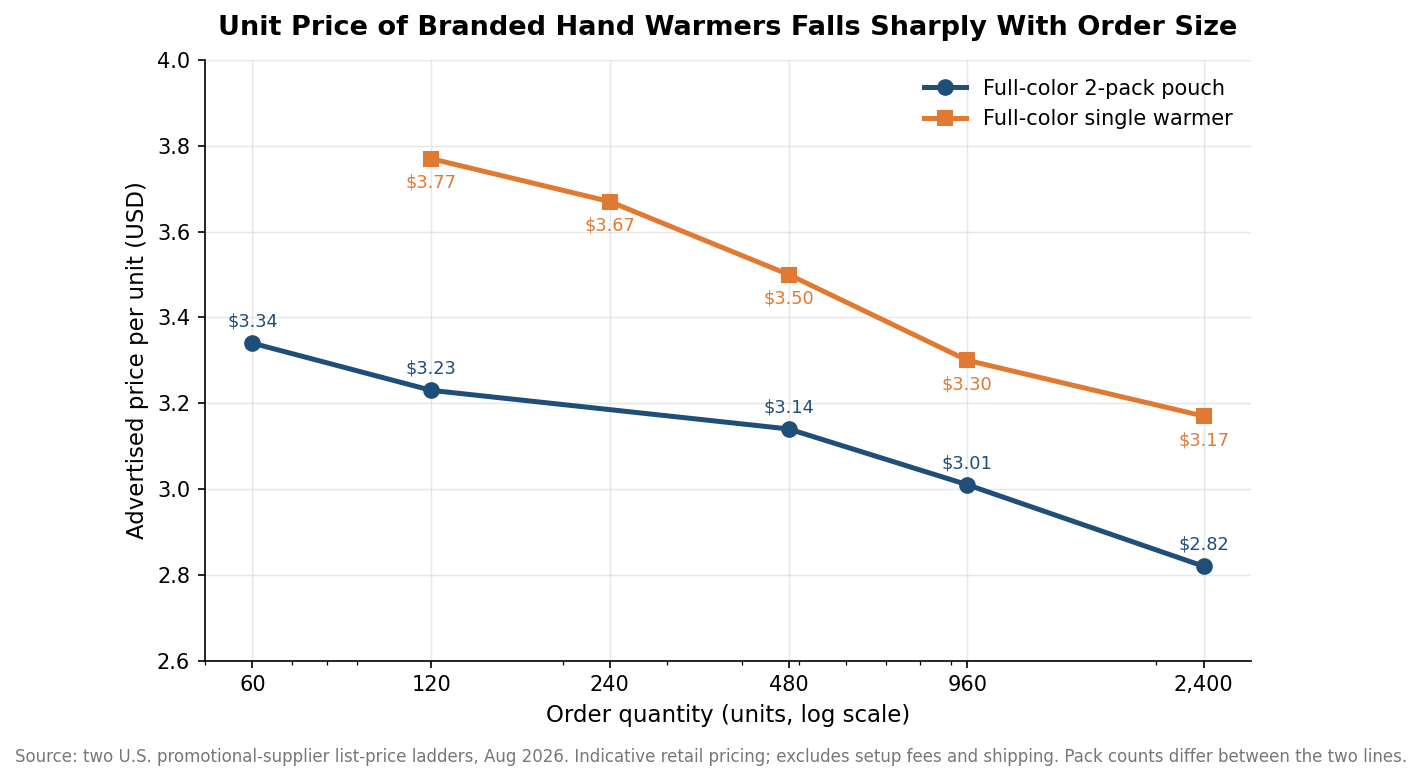
    Volume does the heavy lifting on the per-unit price. The curve is steepest across the first few hundred units, which is worth knowing: nudging an order up in quantity often adds little per piece and leaves you with useful extras, while the shelf life of an air-activated warmer is long enough that overage does not go to waste before next winter.

    Treat this as general guidance rather than a quote for any one job. Actual pricing moves with pack count, print method, ink coverage and quantity, and rush production almost always carries a premium. For a firm number on your design, request a free quote and mockup.

    Lead times and the artwork you need to supply

    Standard production at Customized Hand Warmers is about 2 weeks after design approval, and your free mockup arrives within 24 hours. Faster options may be available with express shipping but tighten in the run-up to the winter holidays and any cold-weather sporting season, so the safe move is to lock artwork well before you actually need the boxes on a table.

    Send the right files and you skip a round of proofs. For a one-color imprint, supply vector art — an AI, EPS, or vector PDF — so the logo stays crisp at any size and the printer can pull a single clean plate. For full-color work, provide a 300 dpi, CMYK layout built to the supplier’s template with the bleed included, and convert any fonts to outlines so nothing reflows. Always ask for a digital proof and, on larger or first-time runs, a physical pre-production sample; color on a matte sachet film can read differently than it does on a screen, and a five-minute check beats reprinting a few thousand pieces.

    Matching the spec to the giveaway

    The right specification follows the moment the warmer is handed over. For a trade-show booth or a product launch where the goal is a memorable, photographable object, the full-color wrap earns its higher unit cost, and a two-pack feels more like a gift than a sample. For a large-scale handout — a 5K start line, a tailgate, a campus event — a one-color imprint on single warmers keeps the per-unit cost low and lets the budget stretch across the crowd. Weddings and small VIP gifts sit in between: full color for the design freedom, but low minimums keep the quantity sane. Decide the scene first, then let it set the print method, the pack count, and the quantity, and the rest of the specification tends to fall into place on its own.
  • Can You Fly With Hand Warmers? Travel and Shipping Rules by Type

    Can You Fly With Hand Warmers? Travel and Shipping Rules by Type

    Hand warmers are a popular winter giveaway and a genuinely useful cold-weather item, but they sit in an awkward spot for anyone who travels with them or ships them in bulk. Whether a warmer is welcome in a carry-on, banned from checked luggage, or treated as regulated dangerous goods depends almost entirely on how the warmer makes heat. Get the type right and the rules are simple. Get it wrong and you have a confiscated product at security or a rejected freight shipment. This is a plain-English guide to which warmer goes where, aimed at buyers ordering branded warmers for events, resale, or employee kits.

    The heat source is what the rules actually care about

    There are three common types, and each is regulated differently. Air-activated disposable warmers make heat through a slow chemical reaction when iron powder meets oxygen. Reusable gel warmers, usually filled with a sodium acetate solution, release heat when a metal disc triggers crystallization. Rechargeable warmers are small electronics powered by a lithium-ion battery. From a compliance standpoint these are three different products, so the first thing to nail down before you order or pack is which one you actually have.

    Disposable air-activated warmers: the easy case

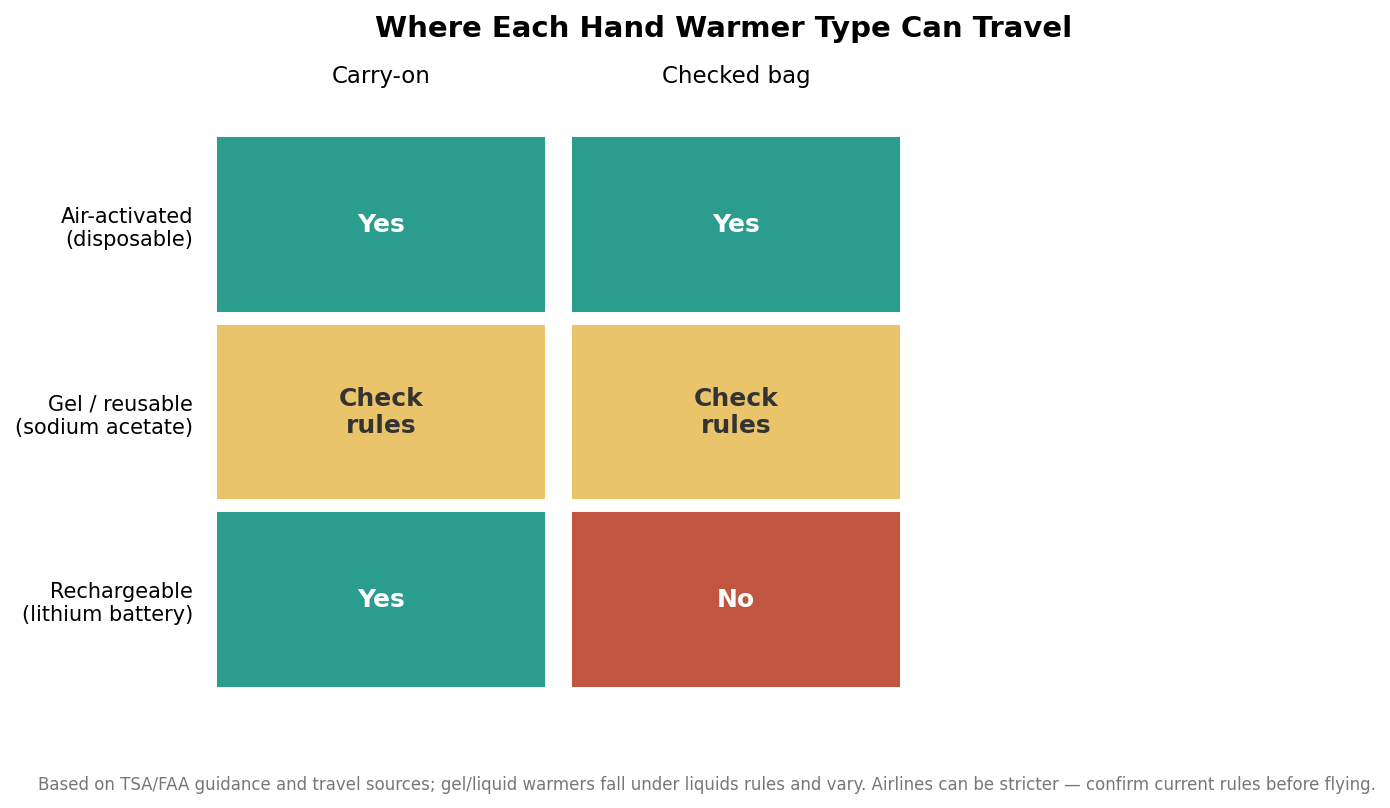
    The single-use, air-activated warmers that most people picture are the least restricted. They contain no liquid and no battery, and they are generally allowed in both carry-on and checked baggage. That makes them the safest choice if the whole point is that recipients can toss them in a bag and fly without a second thought, and it is one reason they remain the default for outdoor events, stadium giveaways, and cold-weather promotions. The only practical caution is that they begin reacting once exposed to air, so they should stay sealed in their original wrapper until use; an opened warmer is simply spent, not dangerous.

    Matrix showing hand warmer travel rules by type: air-activated allowed in carry-on and checked, gel or reusable check the rules for both, rechargeable allowed in carry-on but not checked
    The heat source, not the brand, decides where a hand warmer can travel.

    Rechargeable warmers follow lithium-battery rules

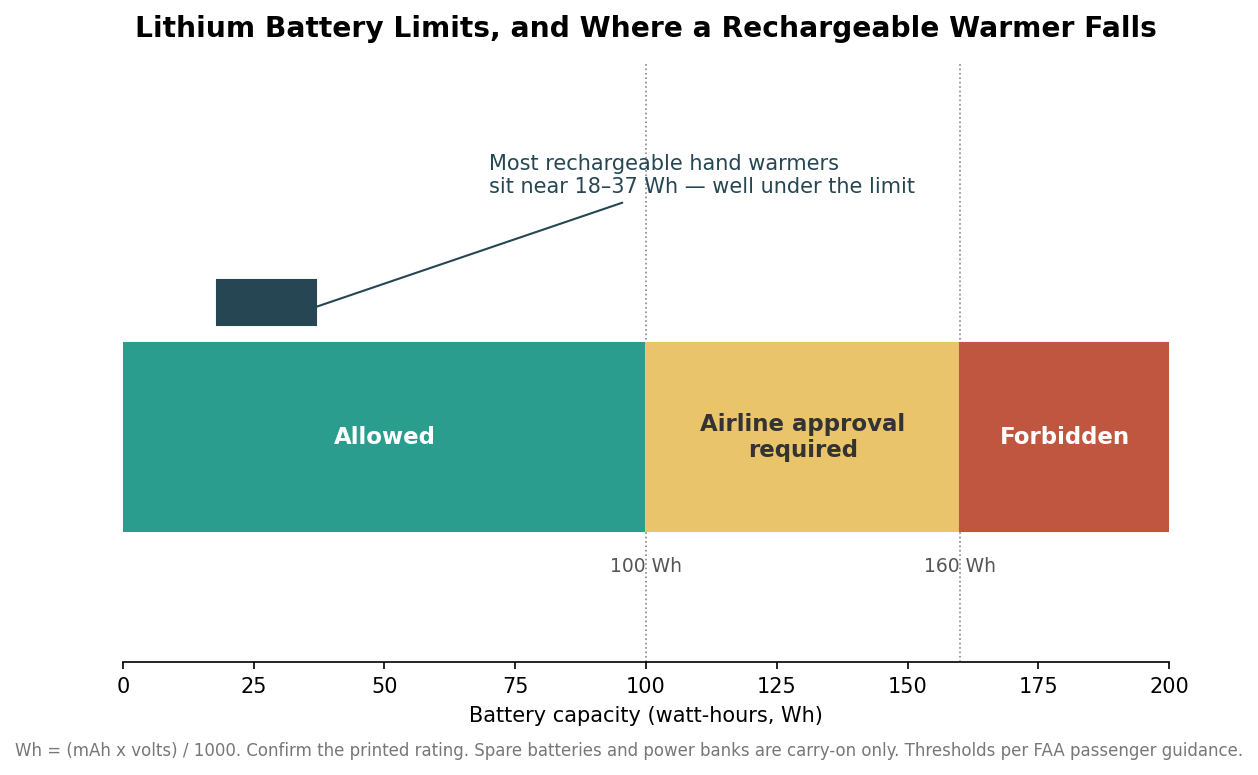
    The moment a warmer has a rechargeable battery, it stops being a novelty item and becomes a lithium-battery device in the eyes of aviation authorities. The governing measure is watt-hours (Wh), which you calculate as milliamp-hours times voltage divided by 1,000. Under FAA passenger guidance, batteries up to 100 Wh are allowed, those from 101 to 160 Wh require airline approval, and anything above 160 Wh is forbidden on passenger aircraft. The good news for buyers is that almost every rechargeable hand warmer is small; a typical unit lands somewhere around 18 to 37 Wh, comfortably inside the allowed zone. Still, the rating should be printed on the device, and if you are sourcing warmers that double as power banks with large capacities, check that number before assuming it clears.

    Watt-hour threshold chart: lithium batteries up to 100 Wh allowed, 100 to 160 Wh need airline approval, above 160 Wh forbidden, with typical rechargeable hand warmers marked at 18 to 37 Wh
    Most rechargeable warmers sit far below the 100 Wh line, but confirm the printed rating.

    The more important rule is where the battery can ride. Spare lithium batteries and power banks must travel in the cabin and cannot be checked, and battery-powered warmers are best treated the same way: keep them in your carry-on, powered off and protected from accidental activation. The reason is thermal runaway, the process by which a damaged or defective lithium cell can overheat without warning, which airlines would rather have happen in the cabin where it can be seen and handled than in an inaccessible cargo hold. If you are assembling branded kits that include rechargeable warmers, it is worth adding a short note telling recipients to pack them in carry-on only.

    Gel and reusable warmers: the gray area

    Sodium acetate gel warmers are the least predictable of the three at the checkpoint. Because they contain a liquid or gel, they can fall under the same screening rules as other liquids, and some travelers report them being restricted or questioned in carry-on bags on flammability and liquid-volume grounds. Guidance is inconsistent across sources and can vary by airport and officer, so the honest answer is that reusable gel warmers are a check-the-current-rules item rather than a clear yes. If you are choosing a warmer specifically so that it travels without friction, this ambiguity is a reason to favor air-activated or a small rechargeable instead.

    Shipping branded warmers in bulk is a separate question

    Everything above concerns a passenger flying with a warmer. Shipping a pallet of them is governed by different rules, and again the battery is the dividing line. Disposable air-activated and gel warmers ship as ordinary consumer goods with no special dangerous-goods paperwork in most cases. Rechargeable warmers contain lithium-ion cells, which are classified as dangerous goods for transport; sending them, especially by air, involves specific packaging, labeling, and documentation requirements, and carriers enforce them strictly. Practically, that means a bulk order of battery warmers may ship more slowly, cost more to send by air, and require your supplier or freight forwarder to handle the lithium-battery compliance. If speed and simplicity matter for a large promotional run, disposable warmers avoid that entire layer of regulation.

    The bottom line for buyers

    Match the warmer type to how it will be handled, not just to how it feels in the hand. If recipients will fly with it or you need to ship large quantities quickly and cheaply, air-activated disposables are the frictionless choice and travel in either bag. If you want a premium, reusable item and everyone stays on the ground, gel warmers are fine, but warn people they are a gray area at airport security. If you want the modern rechargeable experience, choose units with a clearly printed watt-hour rating under 100, tell recipients to keep them in carry-on, and plan for lithium-battery rules on the shipping side. None of these rules are obstacles once you know them; they are just reasons to decide the warmer’s heat source deliberately rather than discovering the restrictions after the order lands. Rules also change and vary by carrier, so confirm the current TSA, FAA, and airline guidance before any trip.

  • Which Hand Warmer for Which Job: A Use-Case Selection Guide

    Which Hand Warmer for Which Job: A Use-Case Selection Guide

    Hand warmers look interchangeable until you match them to an actual job. A stadium giveaway, a full day on a chairlift, a warehouse loading dock and a hunting blind at dawn each reward a different technology, and the wrong pick either runs cold before it is needed or costs far more than the use justifies. Rather than rank warmers from best to worst, this guide sorts them by the situation you are buying for, using the two numbers that decide almost everything: how hot the warmer gets and how long it holds that heat.

    Start with the job, then read the two numbers

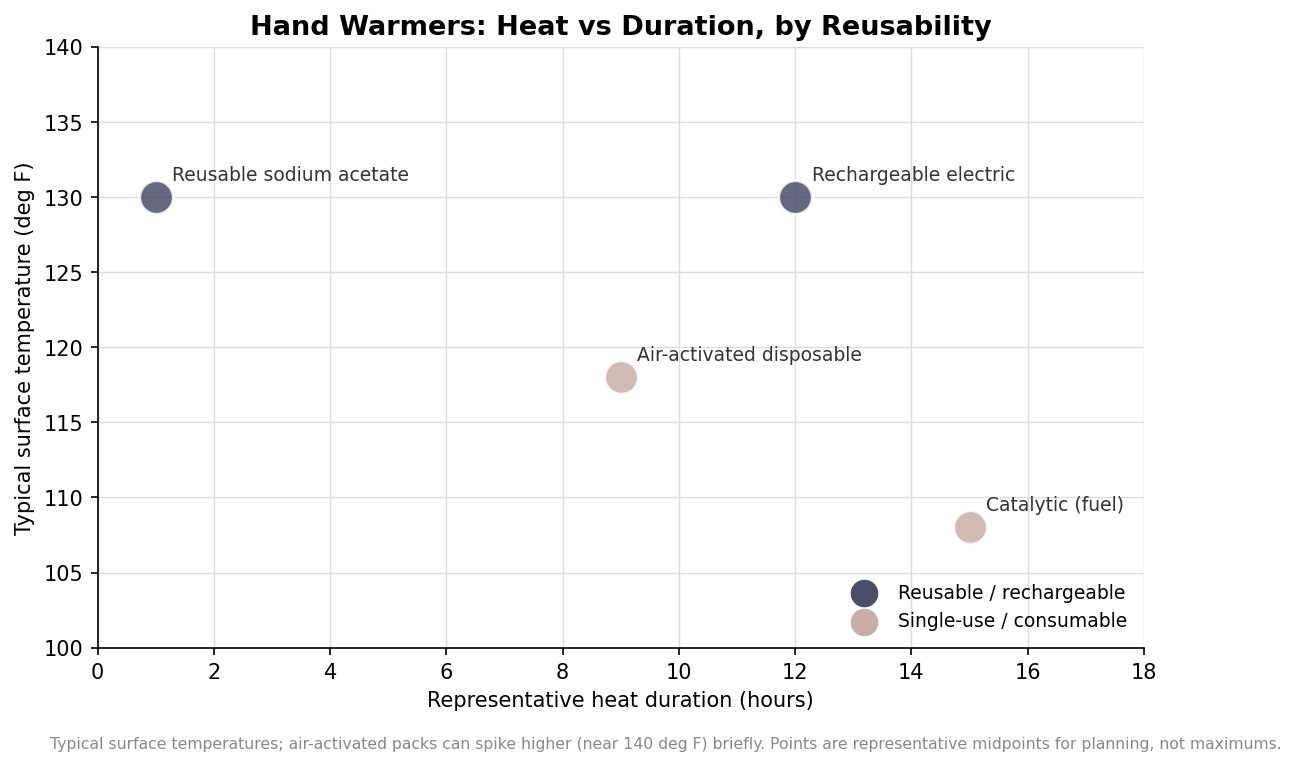
    Every hand warmer trades along the same axes. One is duration, the hours of useful heat from a single unit or charge, and the other is temperature, the surface warmth against the skin. A short, hot burst suits someone standing in the cold for an hour; a long, moderate output suits someone outdoors all day. The chart below plots the four common technologies by heat and duration, and the clusters do the sorting for you: single-use chemical packs and catalytic warmers run long and consumable, while reusable and rechargeable units run warmer but need resetting or recharging. Decide which corner of that space your use lives in before you look at price, because a cheaper warmer that quits early is not cheaper in practice. A useful discipline is to write down the worst case you are buying for, not the average one: the coldest morning, the longest wait, the person who forgets to charge anything. Size the warmer to that case and the ordinary days take care of themselves. It also pays to separate the cost of the warmth from the cost of the object, since a disposable is bought for a single afternoon while a rechargeable is bought for a season or more, and the two only look comparable if you ignore how many times each will actually be used.

    Scatter plot of hand warmer surface temperature versus heat duration, grouped by reusable and single-use types
    Heat against duration for each warmer type, split by whether the unit is reusable or single-use.

    Crowds and short bursts: reusable sodium-acetate packs

    For handing warmth to a crowd that will be cold for a defined, short window, reusable sodium-acetate packs are the natural fit. Clicking a metal disc inside the pouch triggers the supersaturated solution to crystallize and release heat almost instantly, reaching roughly 130 degrees Fahrenheit within seconds. The catch is duration: these packs hold useful heat for only about thirty minutes to two hours depending on size, so they suit a first-quarter kickoff, an outdoor ceremony or a school pickup rather than an all-day outing. Their redeeming feature is that they reset. Drop the pack in boiling water to redissolve the crystals and it is ready again, which makes them a genuinely reusable, low-waste option and an appealing branded keepsake that a recipient uses across a whole season rather than throwing away after one game.

    All-day cold and bulk giveaways: air-activated disposables

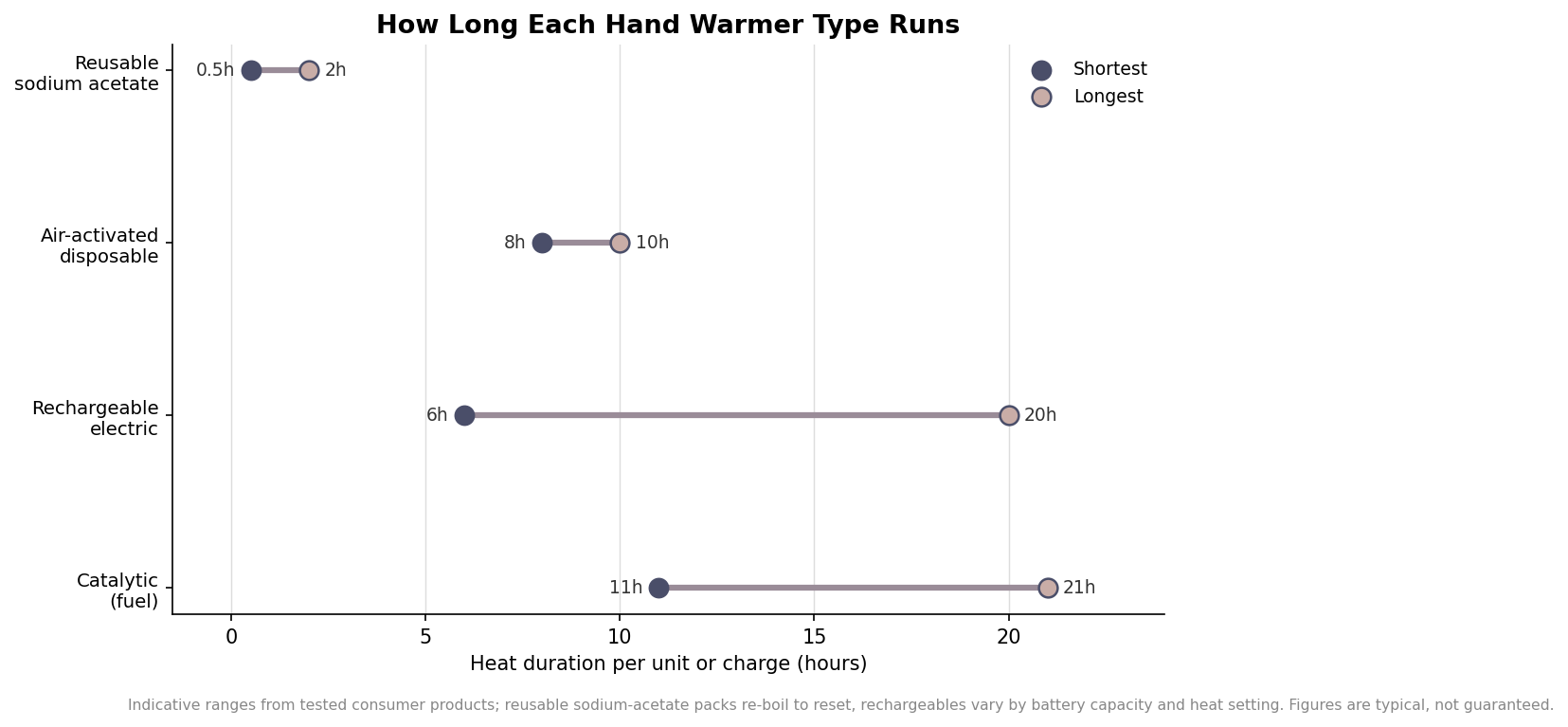
    When the requirement is many hours of hands-off heat at the lowest per-unit cost, air-activated disposables are the workhorse. A porous pouch of iron powder, salt and carbon begins oxidizing the moment it hits air, and that slow rust reaction produces heat for roughly eight to ten hours. Surface temperatures typically sit around the mid-110s Fahrenheit on average, with brief spikes that can approach 140, so they are warm without being adjustable. Because there is nothing to recharge and the outer pouch is a flat printable surface, they are the default for bulk promotional runs: a full-color imprint on the packet is common, and per-unit costs for printed promotional pairs land in the low single dollars. The trade-offs are that they are single-use and cannot be paused once opened, though some designs offer a resealable outer bag to stretch one pack across two shorter outings. The duration chart makes the appeal plain, showing a long, steady run from a unit that costs a fraction of the reusable alternatives.

    Dumbbell dot plot of heat duration range in hours for reusable, air-activated, rechargeable and catalytic hand warmers
    Useful heat duration per unit or charge across the four common hand warmer technologies.

    Repeat users and premium gifts: rechargeable electric

    For a recipient who will reach for the same warmer day after day, a rechargeable electric unit earns its higher price. A lithium battery drives a heating element with three or four selectable settings, typically topping out between 120 and 136 degrees Fahrenheit, and runtime scales with capacity: a 6,000 milliamp-hour unit runs a few hours on high while a 10,000 milliamp-hour unit can stretch toward fifteen or twenty hours across lower settings. Many double as a power bank, which turns the warmer into a genuinely useful year-round gadget rather than a seasonal consumable. That makes them the strongest choice for a premium corporate gift or an employee cold-weather kit, where the cost is justified by repeat use and the adjustable heat lets each person dial in comfort. They are the wrong tool for a thousand-person giveaway, both on unit cost and because batteries need managing, but for a smaller, higher-value audience they are hard to beat.

    Extreme cold, dead batteries, and branding the order

    The specialist case is sustained cold where electronics become a liability. Catalytic warmers burn lighter fuel over a platinum element without a flame, producing a steady, moderate output near 105 to 110 degrees Fahrenheit for anywhere from eleven to twenty-one hours on a fill, and they keep working in deep cold that saps lithium batteries. That reliability is why they persist in hunting camps and long backcountry days, accepting the fuss of refueling in exchange for heat that does not depend on a charge. Whichever technology fits, brief the branding decision alongside it: disposables print on the pouch, reusable packs and rechargeables carry a logo on the unit itself, and each has a different usable print area and lead time. A quick safety note applies across all of them, since even moderate surface temperatures held against skin for hours can cause low-temperature burns, so packaging that advises a fabric layer between warmer and skin is worth specifying. Match the technology to the job first, confirm the heat and duration numbers cover your worst-case use, then choose the branding that fits the surface you actually have.

  • Types of Hand Warmers Compared: Air-Activated, Reusable, and Rechargeable

    Types of Hand Warmers Compared: Air-Activated, Reusable, and Rechargeable

    Not all hand warmers are the same product with different labels. Three distinct technologies sit behind the packets and pouches sold as “hand warmers,” and each one heats a hand in a fundamentally different way. If you are buying for a winter event, a promotional giveaway, or a stadium concession stand, the choice between them decides your cost per unit, how long each warmer lasts, and whether the recipient throws it away or keeps it. This guide compares air-activated disposables, reusable click warmers, and rechargeable electric warmers on the specifications that matter, and then matches each type to the situations where it makes sense.

    Three technologies, three different things happening inside

    Air-activated warmers are the flat, single-use packets most people picture. Inside is a blend of iron powder, salt, water, activated charcoal, and vermiculite or cellulose. When you tear open the outer wrapper, oxygen reaches the iron and drives a controlled oxidation reaction, essentially rapid, contained rusting, that releases heat. There is no battery, no cord, and nothing to flex or click. The reaction runs until the iron is spent, which is why these packets are single use.

    Reusable click warmers work on a completely different principle. A sealed pouch holds a supersaturated sodium acetate solution, and a small stainless steel disc floats inside it. Flexing that disc triggers crystallization that sweeps through the liquid and gives off heat almost instantly. Once it has fully crystallized and cooled, you reset it by boiling the pouch in water until the crystals dissolve back into solution. The same warmer can be reused many times, but each activation is short.

    Rechargeable electric warmers are small lithium-ion devices, usually rounded pebbles or slim bars, with a heating element and one or more temperature settings. They recharge over USB and double as a power bank on some models. They deliver the most consistent, controllable heat of the three, at the cost of the highest unit price and the need to keep them charged.

    Run time: the number people compare first, and misread most

    Run time is where the three technologies separate most sharply, and it is easy to compare the wrong figures. A disposable air-activated hand warmer typically stays warm for up to roughly ten hours once it activates, which is why it suits an all-day outing where nobody wants to think about it again. Toe and foot versions of the same technology run a little shorter, around eight to nine hours, because they are thinner, while large body-warmer patches can run far longer.

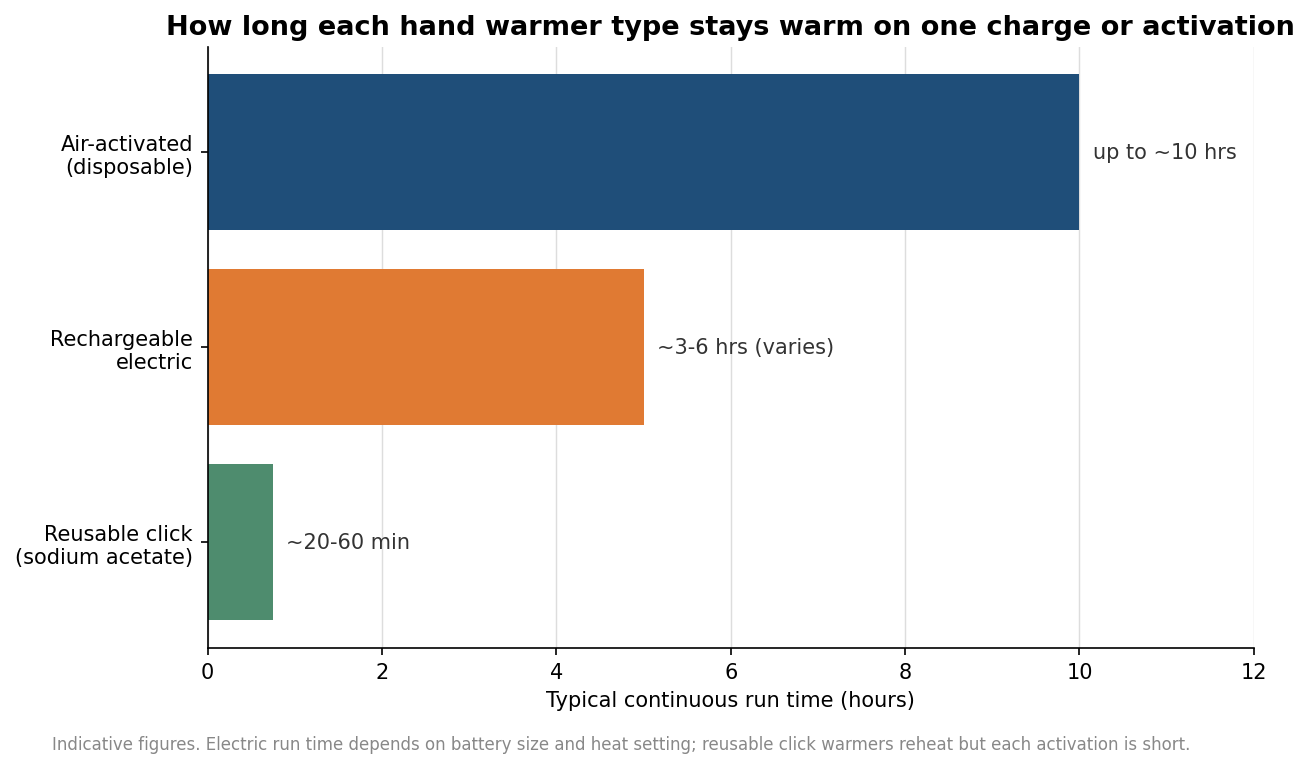
    A rechargeable electric warmer usually delivers somewhere in the range of three to six hours per charge, though that figure swings widely with battery capacity and the heat setting you choose; a higher setting drains the cell faster. A reusable click warmer, by contrast, gives intense heat for only about twenty to sixty minutes before it needs boiling to reset. It is not a lower-quality product, it is simply built for short, repeatable bursts rather than continuous warmth.

    Horizontal bar chart comparing typical run time of air-activated, electric, and reusable click hand warmers
    Air-activated disposables run longest per activation; reusable click warmers give short, repeatable bursts.

    The practical takeaway is that “lasts longer” is not automatically “better.” A commuter who wants ten minutes of heat at a bus stop and reuses the same pouch all winter is well served by a click warmer that a hunter sitting in a blind for eight hours would find useless.

    Temperature, comfort, and the safety margin

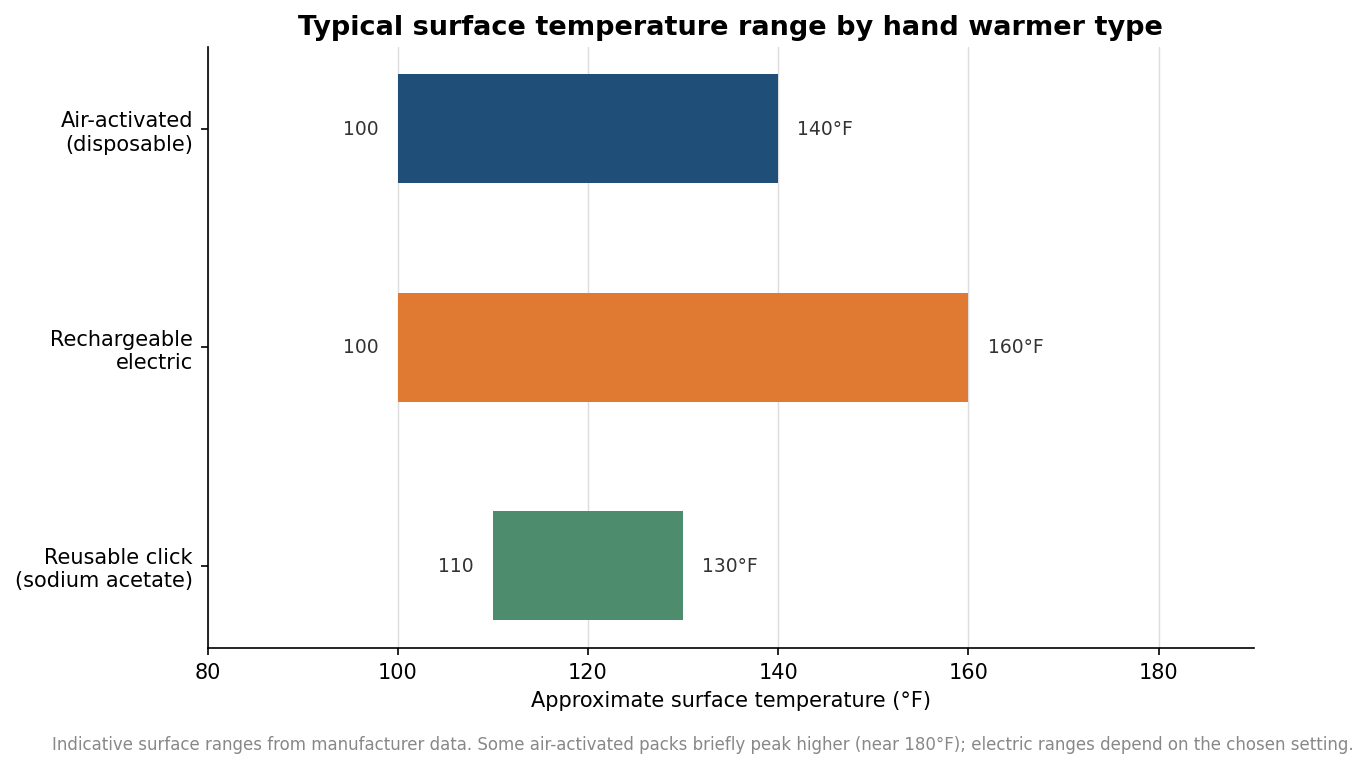
    Surface temperature matters as much as duration, because it determines both comfort and burn risk. Air-activated packets generally sit in the range of about 100 to 140°F at the surface, with some packs briefly peaking higher, near 180°F, shortly after activation. They also need time to get there: most reach their working temperature ten to twenty minutes after air exposure, so handing someone a packet and expecting instant heat leads to disappointment. Electric warmers, with adjustable settings, commonly cover a similar band and let the user dial the heat up or down. Click warmers tend to feel hot immediately but over a narrower range.

    Floating bar chart of surface temperature ranges for three hand warmer types in degrees Fahrenheit
    Typical surface temperature bands; electric warmers let the user adjust within the range.

    Any warmer held against bare skin for a long time carries a low-temperature burn risk, even at temperatures that feel merely warm, because prolonged contact rather than peak heat is what damages tissue. This is why manufacturers direct users to keep warmers in a pocket or glove rather than pressed directly on skin, and why the softer, lower peak of a pocket-carried air-activated packet is often the more comfortable all-day choice despite its unremarkable temperature figures. If you are buying for children, older adults, or anyone with reduced circulation or sensation, lean toward the lower, steadier heat profiles.

    Matching the warmer to the job

    For mass giveaways and single-event handouts, air-activated disposables are usually the right call. They are the cheapest per unit, need no instructions, work straight from the wrapper, and carry a shelf life of around four years, so buying ahead of a season is low risk. Their flat outer pouch is also the easiest surface to print on, which is what makes them the workhorse of branded winter promotions at football games, ski resorts, outdoor markets, and charity walks.

    For a keepsake item that recipients hold onto, a reusable click warmer or an electric warmer earns its higher unit cost by staying in circulation. A branded click warmer that someone reboils all winter, or a logoed electric pebble that lives in a coat pocket for years, delivers far more impressions per unit than a packet used once. The trade-off is a materially higher price and, for electric models, the reality that a flat battery is a dead warmer.

    For resale or concession settings, the math usually favors disposables again, because customers understand them, they require no charging or return, and per-unit economics scale cleanly with volume. Reusable and electric options make more sense as a premium line sitting alongside the disposables rather than as the default.

    Whatever the format, order early. Air-activated stock is seasonal and its long shelf life tempts suppliers to sell through quickly once cold weather hits, so quantities and printing lead times both tighten in late autumn. Decide the technology first, based on how long the heat needs to last and whether the item should survive past one use, and the rest of the specification, size, print method, and quantity, follows from there.

  • How Long Do Hand Warmers Actually Last?

    Duration is the only specification that matters in use, and it is the one least often published. Here is how to read what you are given.

    Same chemistry, different tuning

    Nearly all disposable warmers use iron powder, salt, water, carbon and vermiculite. What differs is the particle size, the carbon content and how breathable the pouch is — all of which control how fast the oxidation runs.

    Faster is hotter and shorter. Slower is cooler and longer. There is no formulation that is both, whatever a listing implies.

    Average temperature is the honest figure

    A published maximum is measured for a moment, usually inside a glove, under ideal conditions. An average temperature over a stated number of hours describes what somebody actually experiences.

    When comparing two products, put them on the same basis: hours to fall below a stated temperature. If one supplier will not give you that, the comparison is not close.

    Conditions change the answer

    Airflow speeds a warmer up and shortens it; a sealed pocket slows it down and can stall it. Cold slows the reaction, which is mildly ironic and worth knowing.

    This is why a warmer that lasted all day in a glove seems to fail in a boot: it is the oxygen, not the product.

    Test before you commit

    Order a small quantity, open one at the start of a shift and check it at the point in the day that matters to you. Twelve warmers is enough to settle an argument that a specification sheet will not.

    Test in the conditions they will be used in, not on a desk. The desk result is always better and always irrelevant.

  • Hand Warmer Safety and Low-Temperature Burns

    Hand warmers are safe products used as intended. The one real risk is the one people do not expect, so it is worth stating plainly.

    What a low-temperature burn is

    Skin can be damaged by prolonged contact with something only moderately warm — well below the temperature that makes you pull your hand away. Hours of contact at a temperature that feels pleasant is enough.

    That is why body patches are formulated to run cool and slow, and why every warmer we make says the same thing on the pack: not directly against bare skin.

    Use a layer, always

    Hand warmers go in a glove or a pocket. Toe warmers go on the outside of a sock. Body patches stick to a base layer, never to skin.

    The adhesive on our patches is chosen for fabric. It is not a skin adhesive and should never be used as one.

    Do not sleep with one

    Sleep removes the feedback that would otherwise make somebody move a warmer that has become uncomfortable. Warmers are for waking hours.

    The same applies to anyone who might not notice: small children, and anyone whose sensation is impaired.

    Reduced sensation means take advice first

    Diabetic neuropathy and other conditions that reduce sensation in the hands or feet remove the warning signal entirely. Anybody in that position should speak to a clinician before using warmers of any type.

    We print that guidance on the pack, in the languages you need, rather than burying it in a leaflet nobody keeps.

    Disposal and storage

    Spent contents are iron oxide, salt and vermiculite — non-toxic, but the sachet is a laminate and is not recyclable in kerbside paper collection.

    Store sealed, cool and dry, and rotate stock by the date on the outer. A damaged outer is a warmer that has already started.

  • The Complete Buyer’s Guide to Custom Hand Warmers

    Four decisions cover this category. Only one of them is about printing, and none of them is about how hot the warmer gets.

    Pick the type by the problem, not the price

    Air-activated warmers are single-use, cheap in quantity and last the longest — they are what you hand out at a gate. Reusable click warmers run half an hour to an hour and recharge by simmering, which makes them right for a season of repeated use and wrong for a long day outdoors.

    Rechargeable electric units are instant, controllable and produce no waste, and they feel like a gift rather than a giveaway. They also cost several times as much and carry lithium freight restrictions.

    Read duration, ignore peak

    Iron, salt and air produce a fixed amount of heat. A warmer that gets very hot very fast is spending that budget early, and it will be cold when the second half starts.

    Ask for hours at an average temperature. Any supplier who will only quote a maximum is telling you which of the two numbers flatters their product.

    Placement changes the chemistry

    An air-activated warmer needs air. Inside a sealed boot there is very little, which is why a hand warmer in a boot disappoints and why toe warmers are a separate, reformulated product with an adhesive backing.

    Body patches are bigger, slower and cooler because they sit against a base layer for most of a day. Using a fast hand warmer that way is how people get low-temperature burns.

    The sachet is the shelf life

    The printed outer is an oxygen barrier. A poor seal means the reaction has already started, so a warmer that arrives lukewarm was usually spent in storage rather than badly made.

    Store sealed and cool, date every outer, and rotate stock. A carton found at the back of a store cupboard two winters later is not a bargain.

    What to send when you ask for a quote

    Type, the duration you actually need, quantity, artwork, and the destination country if electric units are involved. That is enough for a real quote and a mockup the same day.

    Say how the stock will be sold too — pairs at a kiosk, tens in a works store, hundreds at a gate — because the counts and the display are quoted from that.