Not all hand warmers are the same product with different labels. Three distinct technologies sit behind the packets and pouches sold as “hand warmers,” and each one heats a hand in a fundamentally different way. If you are buying for a winter event, a promotional giveaway, or a stadium concession stand, the choice between them decides your cost per unit, how long each warmer lasts, and whether the recipient throws it away or keeps it. This guide compares air-activated disposables, reusable click warmers, and rechargeable electric warmers on the specifications that matter, and then matches each type to the situations where it makes sense.
Three technologies, three different things happening inside
Air-activated warmers are the flat, single-use packets most people picture. Inside is a blend of iron powder, salt, water, activated charcoal, and vermiculite or cellulose. When you tear open the outer wrapper, oxygen reaches the iron and drives a controlled oxidation reaction, essentially rapid, contained rusting, that releases heat. There is no battery, no cord, and nothing to flex or click. The reaction runs until the iron is spent, which is why these packets are single use.
Reusable click warmers work on a completely different principle. A sealed pouch holds a supersaturated sodium acetate solution, and a small stainless steel disc floats inside it. Flexing that disc triggers crystallization that sweeps through the liquid and gives off heat almost instantly. Once it has fully crystallized and cooled, you reset it by boiling the pouch in water until the crystals dissolve back into solution. The same warmer can be reused many times, but each activation is short.
Rechargeable electric warmers are small lithium-ion devices, usually rounded pebbles or slim bars, with a heating element and one or more temperature settings. They recharge over USB and double as a power bank on some models. They deliver the most consistent, controllable heat of the three, at the cost of the highest unit price and the need to keep them charged.
Run time: the number people compare first, and misread most
Run time is where the three technologies separate most sharply, and it is easy to compare the wrong figures. A disposable air-activated hand warmer typically stays warm for up to roughly ten hours once it activates, which is why it suits an all-day outing where nobody wants to think about it again. Toe and foot versions of the same technology run a little shorter, around eight to nine hours, because they are thinner, while large body-warmer patches can run far longer.
A rechargeable electric warmer usually delivers somewhere in the range of three to six hours per charge, though that figure swings widely with battery capacity and the heat setting you choose; a higher setting drains the cell faster. A reusable click warmer, by contrast, gives intense heat for only about twenty to sixty minutes before it needs boiling to reset. It is not a lower-quality product, it is simply built for short, repeatable bursts rather than continuous warmth.
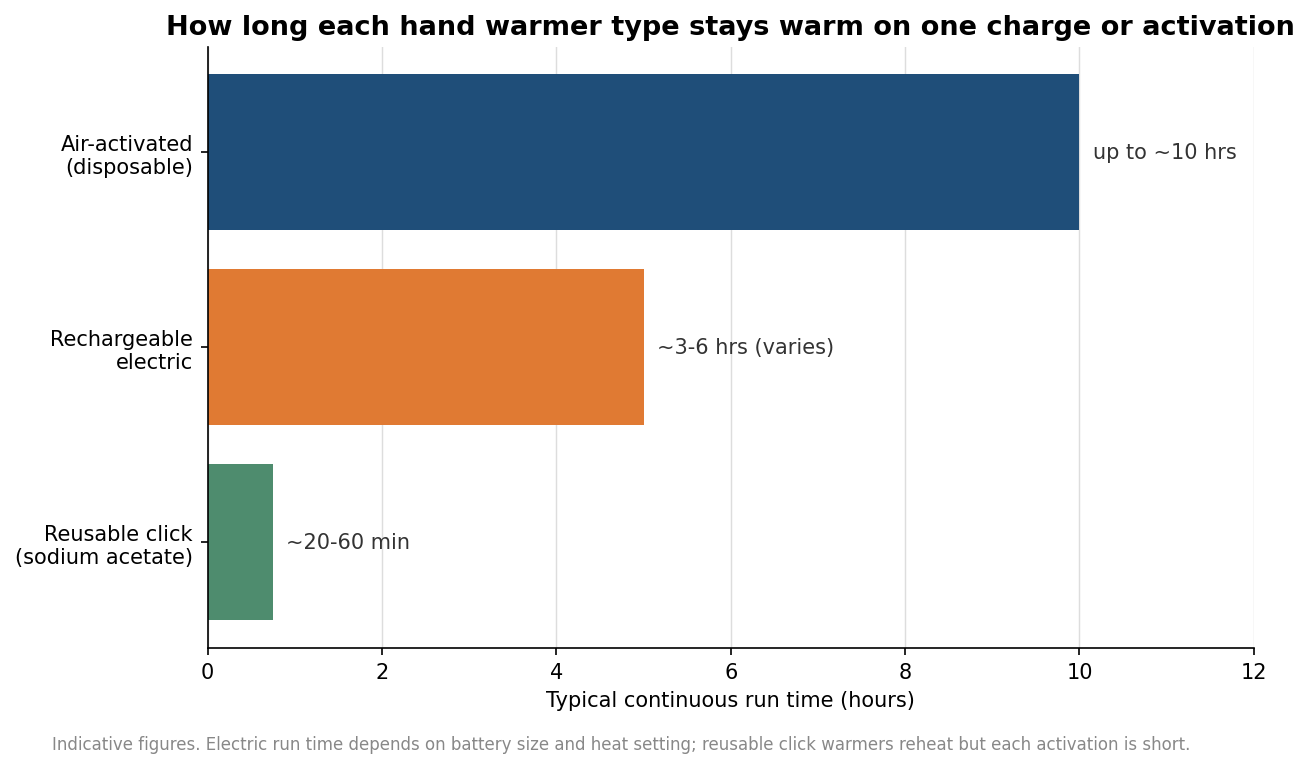
The practical takeaway is that “lasts longer” is not automatically “better.” A commuter who wants ten minutes of heat at a bus stop and reuses the same pouch all winter is well served by a click warmer that a hunter sitting in a blind for eight hours would find useless.
Temperature, comfort, and the safety margin
Surface temperature matters as much as duration, because it determines both comfort and burn risk. Air-activated packets generally sit in the range of about 100 to 140°F at the surface, with some packs briefly peaking higher, near 180°F, shortly after activation. They also need time to get there: most reach their working temperature ten to twenty minutes after air exposure, so handing someone a packet and expecting instant heat leads to disappointment. Electric warmers, with adjustable settings, commonly cover a similar band and let the user dial the heat up or down. Click warmers tend to feel hot immediately but over a narrower range.
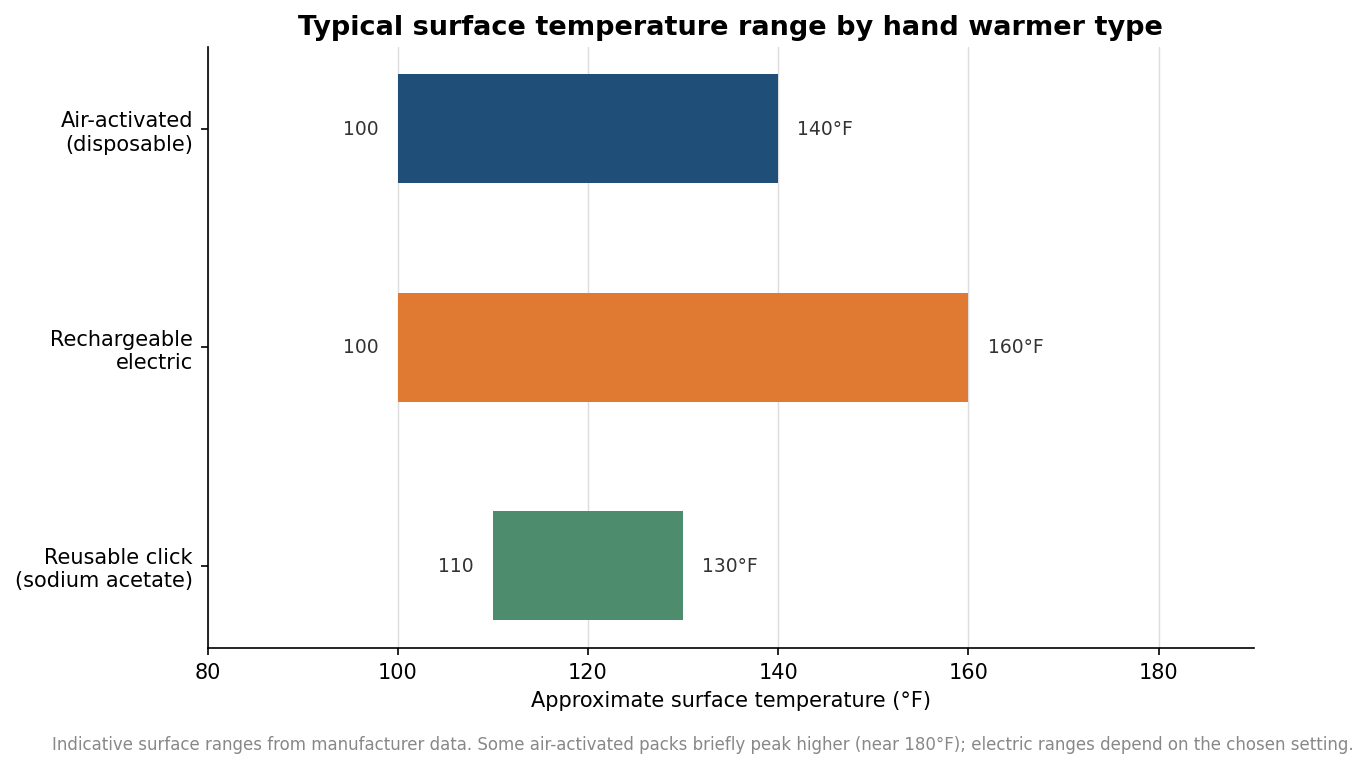
Any warmer held against bare skin for a long time carries a low-temperature burn risk, even at temperatures that feel merely warm, because prolonged contact rather than peak heat is what damages tissue. This is why manufacturers direct users to keep warmers in a pocket or glove rather than pressed directly on skin, and why the softer, lower peak of a pocket-carried air-activated packet is often the more comfortable all-day choice despite its unremarkable temperature figures. If you are buying for children, older adults, or anyone with reduced circulation or sensation, lean toward the lower, steadier heat profiles.
Matching the warmer to the job
For mass giveaways and single-event handouts, air-activated disposables are usually the right call. They are the cheapest per unit, need no instructions, work straight from the wrapper, and carry a shelf life of around four years, so buying ahead of a season is low risk. Their flat outer pouch is also the easiest surface to print on, which is what makes them the workhorse of branded winter promotions at football games, ski resorts, outdoor markets, and charity walks.
For a keepsake item that recipients hold onto, a reusable click warmer or an electric warmer earns its higher unit cost by staying in circulation. A branded click warmer that someone reboils all winter, or a logoed electric pebble that lives in a coat pocket for years, delivers far more impressions per unit than a packet used once. The trade-off is a materially higher price and, for electric models, the reality that a flat battery is a dead warmer.
For resale or concession settings, the math usually favors disposables again, because customers understand them, they require no charging or return, and per-unit economics scale cleanly with volume. Reusable and electric options make more sense as a premium line sitting alongside the disposables rather than as the default.
Whatever the format, order early. Air-activated stock is seasonal and its long shelf life tempts suppliers to sell through quickly once cold weather hits, so quantities and printing lead times both tighten in late autumn. Decide the technology first, based on how long the heat needs to last and whether the item should survive past one use, and the rest of the specification, size, print method, and quantity, follows from there.