Hand warmers look interchangeable until you match them to an actual job. A stadium giveaway, a full day on a chairlift, a warehouse loading dock and a hunting blind at dawn each reward a different technology, and the wrong pick either runs cold before it is needed or costs far more than the use justifies. Rather than rank warmers from best to worst, this guide sorts them by the situation you are buying for, using the two numbers that decide almost everything: how hot the warmer gets and how long it holds that heat.
Start with the job, then read the two numbers
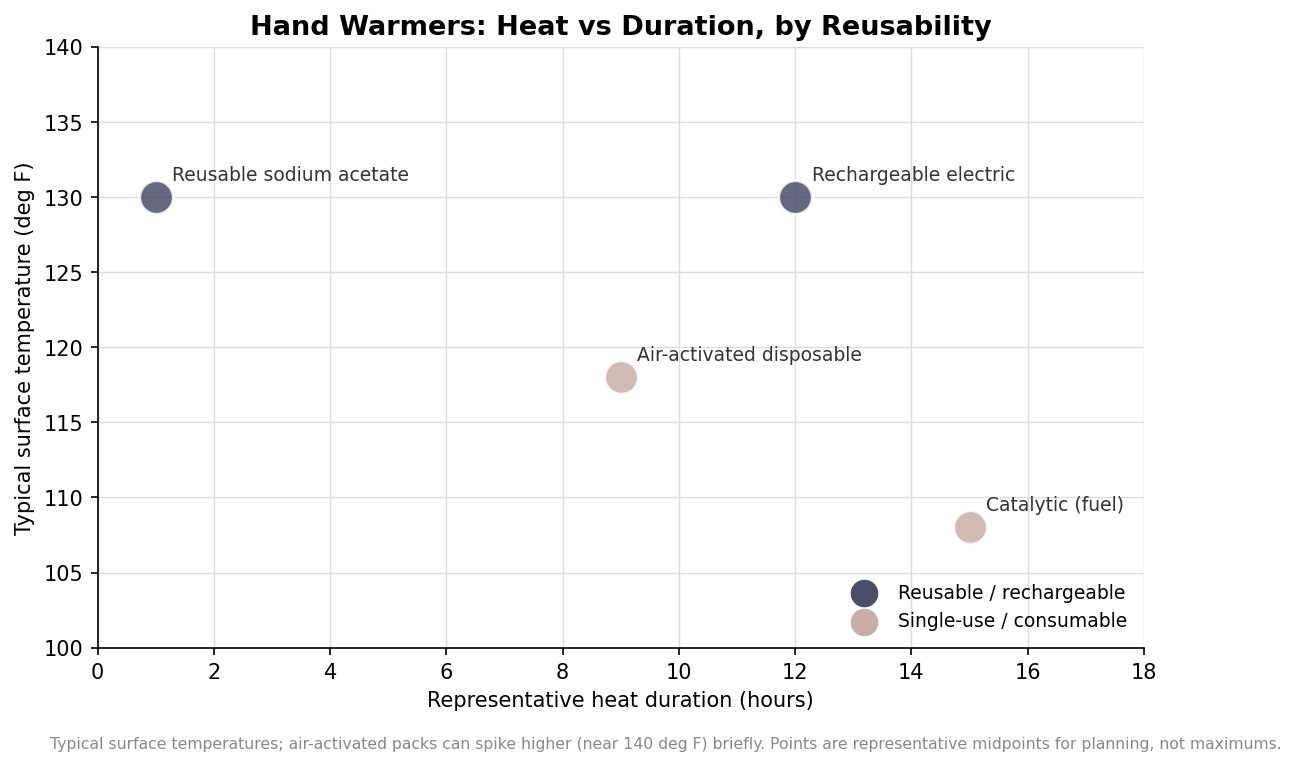
Every hand warmer trades along the same axes. One is duration, the hours of useful heat from a single unit or charge, and the other is temperature, the surface warmth against the skin. A short, hot burst suits someone standing in the cold for an hour; a long, moderate output suits someone outdoors all day. The chart below plots the four common technologies by heat and duration, and the clusters do the sorting for you: single-use chemical packs and catalytic warmers run long and consumable, while reusable and rechargeable units run warmer but need resetting or recharging. Decide which corner of that space your use lives in before you look at price, because a cheaper warmer that quits early is not cheaper in practice. A useful discipline is to write down the worst case you are buying for, not the average one: the coldest morning, the longest wait, the person who forgets to charge anything. Size the warmer to that case and the ordinary days take care of themselves. It also pays to separate the cost of the warmth from the cost of the object, since a disposable is bought for a single afternoon while a rechargeable is bought for a season or more, and the two only look comparable if you ignore how many times each will actually be used.
Crowds and short bursts: reusable sodium-acetate packs
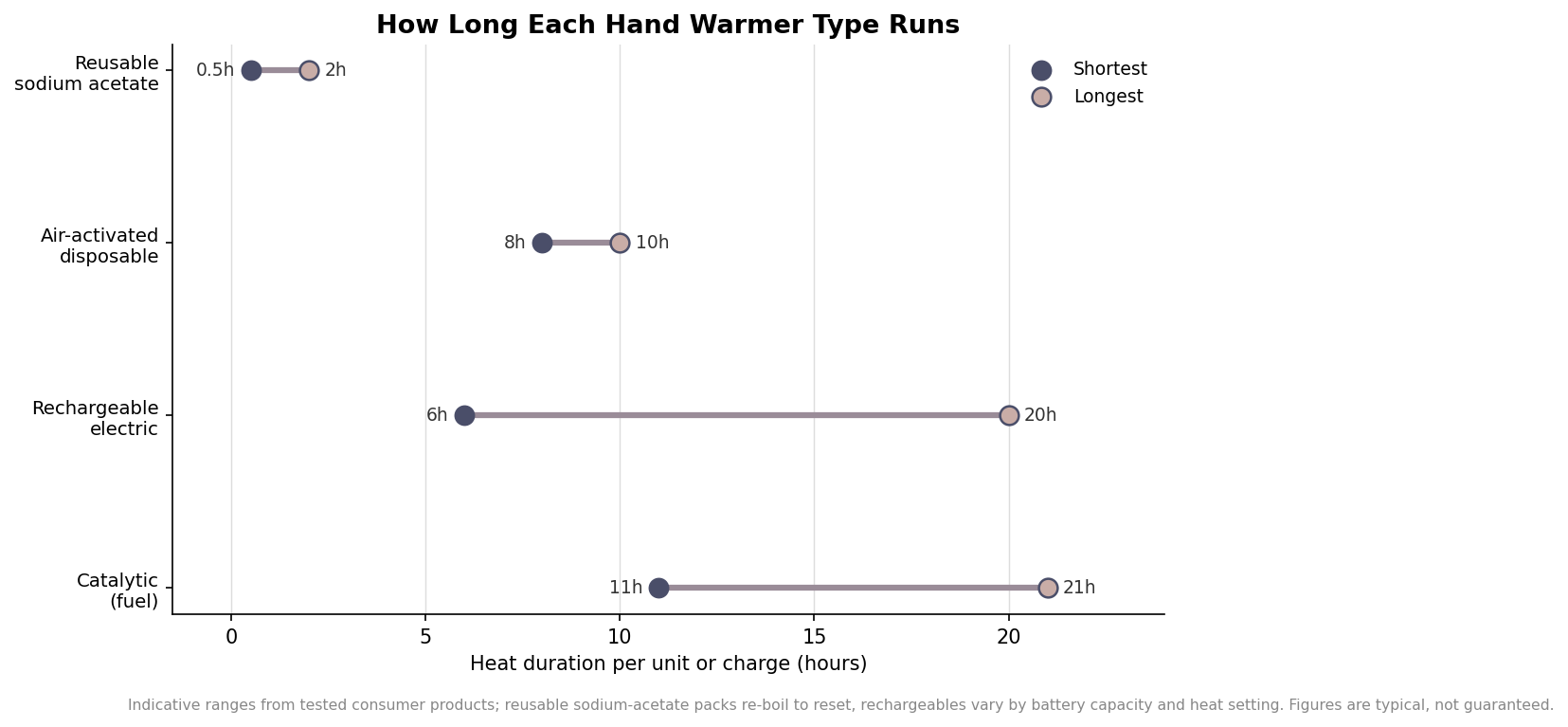
For handing warmth to a crowd that will be cold for a defined, short window, reusable sodium-acetate packs are the natural fit. Clicking a metal disc inside the pouch triggers the supersaturated solution to crystallize and release heat almost instantly, reaching roughly 130 degrees Fahrenheit within seconds. The catch is duration: these packs hold useful heat for only about thirty minutes to two hours depending on size, so they suit a first-quarter kickoff, an outdoor ceremony or a school pickup rather than an all-day outing. Their redeeming feature is that they reset. Drop the pack in boiling water to redissolve the crystals and it is ready again, which makes them a genuinely reusable, low-waste option and an appealing branded keepsake that a recipient uses across a whole season rather than throwing away after one game.
All-day cold and bulk giveaways: air-activated disposables
When the requirement is many hours of hands-off heat at the lowest per-unit cost, air-activated disposables are the workhorse. A porous pouch of iron powder, salt and carbon begins oxidizing the moment it hits air, and that slow rust reaction produces heat for roughly eight to ten hours. Surface temperatures typically sit around the mid-110s Fahrenheit on average, with brief spikes that can approach 140, so they are warm without being adjustable. Because there is nothing to recharge and the outer pouch is a flat printable surface, they are the default for bulk promotional runs: a full-color imprint on the packet is common, and per-unit costs for printed promotional pairs land in the low single dollars. The trade-offs are that they are single-use and cannot be paused once opened, though some designs offer a resealable outer bag to stretch one pack across two shorter outings. The duration chart makes the appeal plain, showing a long, steady run from a unit that costs a fraction of the reusable alternatives.
Repeat users and premium gifts: rechargeable electric
For a recipient who will reach for the same warmer day after day, a rechargeable electric unit earns its higher price. A lithium battery drives a heating element with three or four selectable settings, typically topping out between 120 and 136 degrees Fahrenheit, and runtime scales with capacity: a 6,000 milliamp-hour unit runs a few hours on high while a 10,000 milliamp-hour unit can stretch toward fifteen or twenty hours across lower settings. Many double as a power bank, which turns the warmer into a genuinely useful year-round gadget rather than a seasonal consumable. That makes them the strongest choice for a premium corporate gift or an employee cold-weather kit, where the cost is justified by repeat use and the adjustable heat lets each person dial in comfort. They are the wrong tool for a thousand-person giveaway, both on unit cost and because batteries need managing, but for a smaller, higher-value audience they are hard to beat.
Extreme cold, dead batteries, and branding the order
The specialist case is sustained cold where electronics become a liability. Catalytic warmers burn lighter fuel over a platinum element without a flame, producing a steady, moderate output near 105 to 110 degrees Fahrenheit for anywhere from eleven to twenty-one hours on a fill, and they keep working in deep cold that saps lithium batteries. That reliability is why they persist in hunting camps and long backcountry days, accepting the fuss of refueling in exchange for heat that does not depend on a charge. Whichever technology fits, brief the branding decision alongside it: disposables print on the pouch, reusable packs and rechargeables carry a logo on the unit itself, and each has a different usable print area and lead time. A quick safety note applies across all of them, since even moderate surface temperatures held against skin for hours can cause low-temperature burns, so packaging that advises a fabric layer between warmer and skin is worth specifying. Match the technology to the job first, confirm the heat and duration numbers cover your worst-case use, then choose the branding that fits the surface you actually have.