A branded hand warmer is one of the few giveaways people actually keep in a pocket and use, which is why the print specification deserves more thought than it usually gets. The warmer itself is a sealed sachet of iron powder, salt, activated carbon, and vermiculite that heats up when the pouch is opened and the iron begins to oxidize in air. That reaction typically reaches somewhere around 126 to 144°F and holds usable heat for roughly eight to ten hours, depending on the size of the sachet. Adding your brand does not change any of that. What it changes is the wrapper, and there are two very different ways to put a logo on it.
Two routes to get your brand on the wrapper
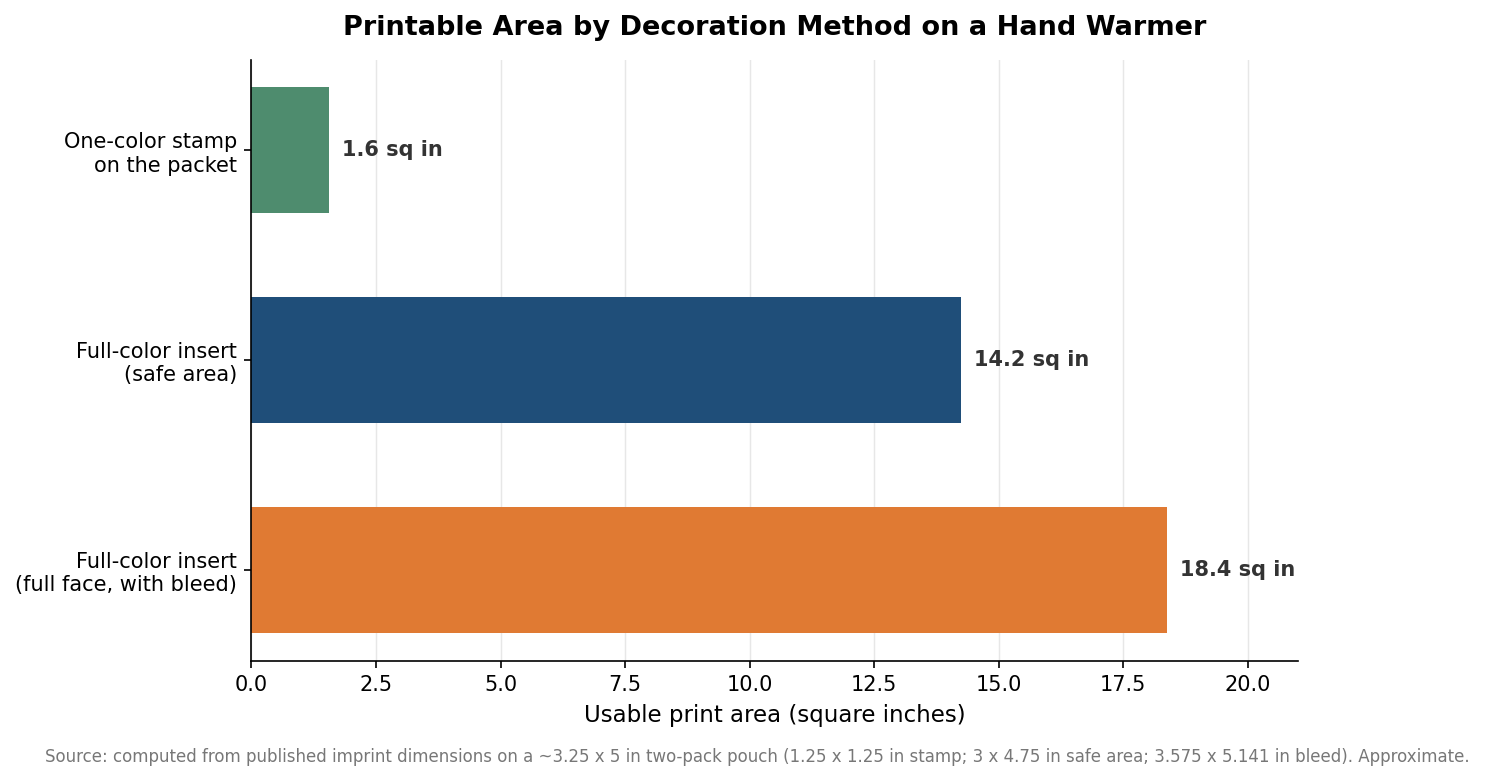
The first route is a direct imprint on the sealed packet. A single ink color is printed onto the existing film in one location, usually inside a small window of about 1.25 inches square. Because it reuses stock packaging and a single screen, this method carries the lowest setup effort and the simplest quote. For a plain logo, a URL, or an event name, it is hard to beat on price.
The second route is a full-color printed insert or label that covers the entire face of the pack. Here the artwork is printed on its own stock and either wrapped around or inserted with the warmer, so you get four-color process printing across the whole front. On a common two-pack pouch measuring roughly 3.25 by 5 inches, the safe print area runs about 3 by 4.75 inches, and the design bleeds out to around 3.575 by 5.141 inches so the ink runs off the edge cleanly. This is the route to choose when you want a photograph, a gradient, a sponsor lockup, or a scannable QR code, and it is what most trade-show and retail programs use. Setup is more involved, and the unit price depends on quantity and on whether the pack holds one warmer or two.
What you can actually print, and how big
The gap between those two methods is not subtle. A one-color stamp gives you well under two square inches to work with, while a full-color insert opens up roughly fourteen square inches of safe area, or a little over eighteen once you count the bleed. That is close to a tenfold difference in usable canvas, and it is the single biggest reason a program moves from a stamp to a wrap.
Two dimensions matter when you lay out the art. The safe area is where anything you cannot afford to lose — logos, legal copy, a phone number — has to live, because trimming and folding tolerances eat a few millimeters at every edge. The bleed is the slightly larger rectangle you extend background color and imagery into so that no unprinted white sliver shows if the cut drifts. Keep type and key marks inside the safe area, push backgrounds out to the bleed, and the piece will look intentional rather than cropped. Because the warmer is a soft, slightly puffy sachet, avoid thin hairline rules and tiny reversed-out text that can distort when the pack flexes.
Minimums, setup, and what really drives the price
Three things decide what a run costs: the quantity, the number of print colors, and the pack count. Customized Hand Warmers starts at a minimum order of 12 per design, so a small team giveaway and a stadium promotion are both easy to order. Spot color stays simple while you need one or two inks; once you are past two colors, full-color process is usually the better-looking choice and no harder to set up.
Volume does the heavy lifting on the per-unit price. The curve is steepest across the first few hundred units, which is worth knowing: nudging an order up in quantity often adds little per piece and leaves you with useful extras, while the shelf life of an air-activated warmer is long enough that overage does not go to waste before next winter.
Treat this as general guidance rather than a quote for any one job. Actual pricing moves with pack count, print method, ink coverage and quantity, and rush production almost always carries a premium. For a firm number on your design, request a free quote and mockup.
Lead times and the artwork you need to supply
Standard production at Customized Hand Warmers is about 2 weeks after design approval, and your free mockup arrives within 24 hours. Faster options may be available with express shipping but tighten in the run-up to the winter holidays and any cold-weather sporting season, so the safe move is to lock artwork well before you actually need the boxes on a table.
Send the right files and you skip a round of proofs. For a one-color imprint, supply vector art — an AI, EPS, or vector PDF — so the logo stays crisp at any size and the printer can pull a single clean plate. For full-color work, provide a 300 dpi, CMYK layout built to the supplier’s template with the bleed included, and convert any fonts to outlines so nothing reflows. Always ask for a digital proof and, on larger or first-time runs, a physical pre-production sample; color on a matte sachet film can read differently than it does on a screen, and a five-minute check beats reprinting a few thousand pieces.
Matching the spec to the giveaway
The right specification follows the moment the warmer is handed over. For a trade-show booth or a product launch where the goal is a memorable, photographable object, the full-color wrap earns its higher unit cost, and a two-pack feels more like a gift than a sample. For a large-scale handout — a 5K start line, a tailgate, a campus event — a one-color imprint on single warmers keeps the per-unit cost low and lets the budget stretch across the crowd. Weddings and small VIP gifts sit in between: full color for the design freedom, but low minimums keep the quantity sane. Decide the scene first, then let it set the print method, the pack count, and the quantity, and the rest of the specification tends to fall into place on its own.