Hand warmers are a popular winter giveaway and a genuinely useful cold-weather item, but they sit in an awkward spot for anyone who travels with them or ships them in bulk. Whether a warmer is welcome in a carry-on, banned from checked luggage, or treated as regulated dangerous goods depends almost entirely on how the warmer makes heat. Get the type right and the rules are simple. Get it wrong and you have a confiscated product at security or a rejected freight shipment. This is a plain-English guide to which warmer goes where, aimed at buyers ordering branded warmers for events, resale, or employee kits.
The heat source is what the rules actually care about
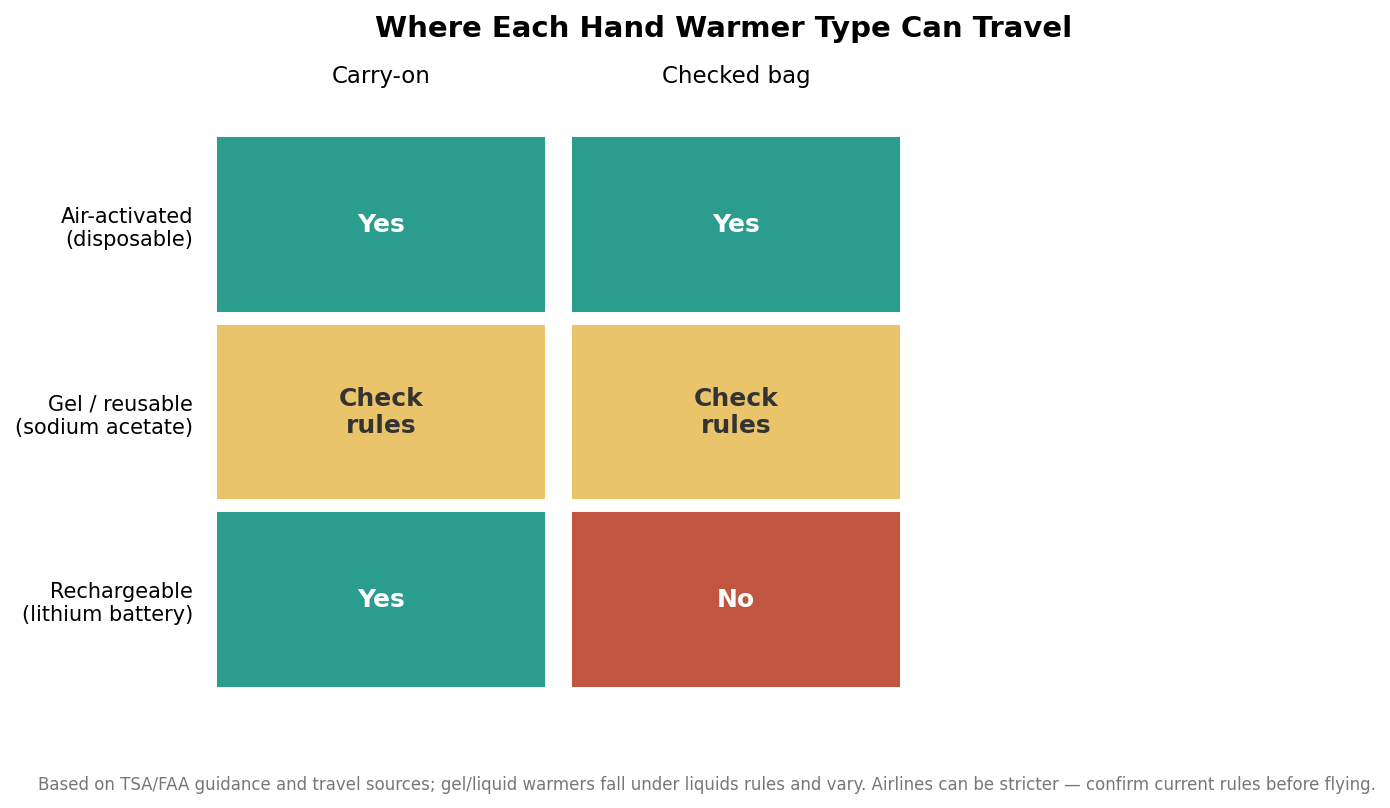
There are three common types, and each is regulated differently. Air-activated disposable warmers make heat through a slow chemical reaction when iron powder meets oxygen. Reusable gel warmers, usually filled with a sodium acetate solution, release heat when a metal disc triggers crystallization. Rechargeable warmers are small electronics powered by a lithium-ion battery. From a compliance standpoint these are three different products, so the first thing to nail down before you order or pack is which one you actually have.
Disposable air-activated warmers: the easy case
The single-use, air-activated warmers that most people picture are the least restricted. They contain no liquid and no battery, and they are generally allowed in both carry-on and checked baggage. That makes them the safest choice if the whole point is that recipients can toss them in a bag and fly without a second thought, and it is one reason they remain the default for outdoor events, stadium giveaways, and cold-weather promotions. The only practical caution is that they begin reacting once exposed to air, so they should stay sealed in their original wrapper until use; an opened warmer is simply spent, not dangerous.
Rechargeable warmers follow lithium-battery rules
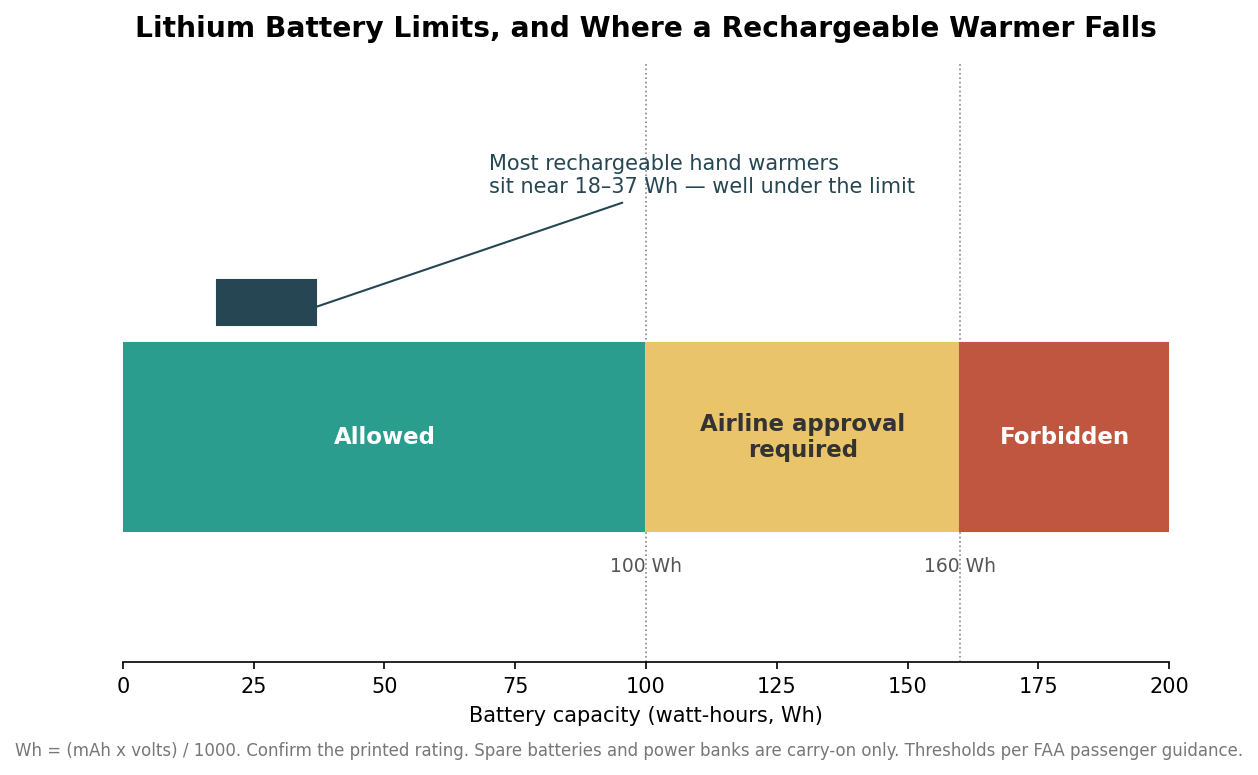
The moment a warmer has a rechargeable battery, it stops being a novelty item and becomes a lithium-battery device in the eyes of aviation authorities. The governing measure is watt-hours (Wh), which you calculate as milliamp-hours times voltage divided by 1,000. Under FAA passenger guidance, batteries up to 100 Wh are allowed, those from 101 to 160 Wh require airline approval, and anything above 160 Wh is forbidden on passenger aircraft. The good news for buyers is that almost every rechargeable hand warmer is small; a typical unit lands somewhere around 18 to 37 Wh, comfortably inside the allowed zone. Still, the rating should be printed on the device, and if you are sourcing warmers that double as power banks with large capacities, check that number before assuming it clears.
The more important rule is where the battery can ride. Spare lithium batteries and power banks must travel in the cabin and cannot be checked, and battery-powered warmers are best treated the same way: keep them in your carry-on, powered off and protected from accidental activation. The reason is thermal runaway, the process by which a damaged or defective lithium cell can overheat without warning, which airlines would rather have happen in the cabin where it can be seen and handled than in an inaccessible cargo hold. If you are assembling branded kits that include rechargeable warmers, it is worth adding a short note telling recipients to pack them in carry-on only.
Gel and reusable warmers: the gray area
Sodium acetate gel warmers are the least predictable of the three at the checkpoint. Because they contain a liquid or gel, they can fall under the same screening rules as other liquids, and some travelers report them being restricted or questioned in carry-on bags on flammability and liquid-volume grounds. Guidance is inconsistent across sources and can vary by airport and officer, so the honest answer is that reusable gel warmers are a check-the-current-rules item rather than a clear yes. If you are choosing a warmer specifically so that it travels without friction, this ambiguity is a reason to favor air-activated or a small rechargeable instead.
Shipping branded warmers in bulk is a separate question
Everything above concerns a passenger flying with a warmer. Shipping a pallet of them is governed by different rules, and again the battery is the dividing line. Disposable air-activated and gel warmers ship as ordinary consumer goods with no special dangerous-goods paperwork in most cases. Rechargeable warmers contain lithium-ion cells, which are classified as dangerous goods for transport; sending them, especially by air, involves specific packaging, labeling, and documentation requirements, and carriers enforce them strictly. Practically, that means a bulk order of battery warmers may ship more slowly, cost more to send by air, and require your supplier or freight forwarder to handle the lithium-battery compliance. If speed and simplicity matter for a large promotional run, disposable warmers avoid that entire layer of regulation.
The bottom line for buyers
Match the warmer type to how it will be handled, not just to how it feels in the hand. If recipients will fly with it or you need to ship large quantities quickly and cheaply, air-activated disposables are the frictionless choice and travel in either bag. If you want a premium, reusable item and everyone stays on the ground, gel warmers are fine, but warn people they are a gray area at airport security. If you want the modern rechargeable experience, choose units with a clearly printed watt-hour rating under 100, tell recipients to keep them in carry-on, and plan for lithium-battery rules on the shipping side. None of these rules are obstacles once you know them; they are just reasons to decide the warmer’s heat source deliberately rather than discovering the restrictions after the order lands. Rules also change and vary by carrier, so confirm the current TSA, FAA, and airline guidance before any trip.